Day, Night, and Weather in Bus Simulator 27
Seamless transitions, dynamic rain, night driving, and the equipment you need to operate safely in every condition across Felicia Bay.
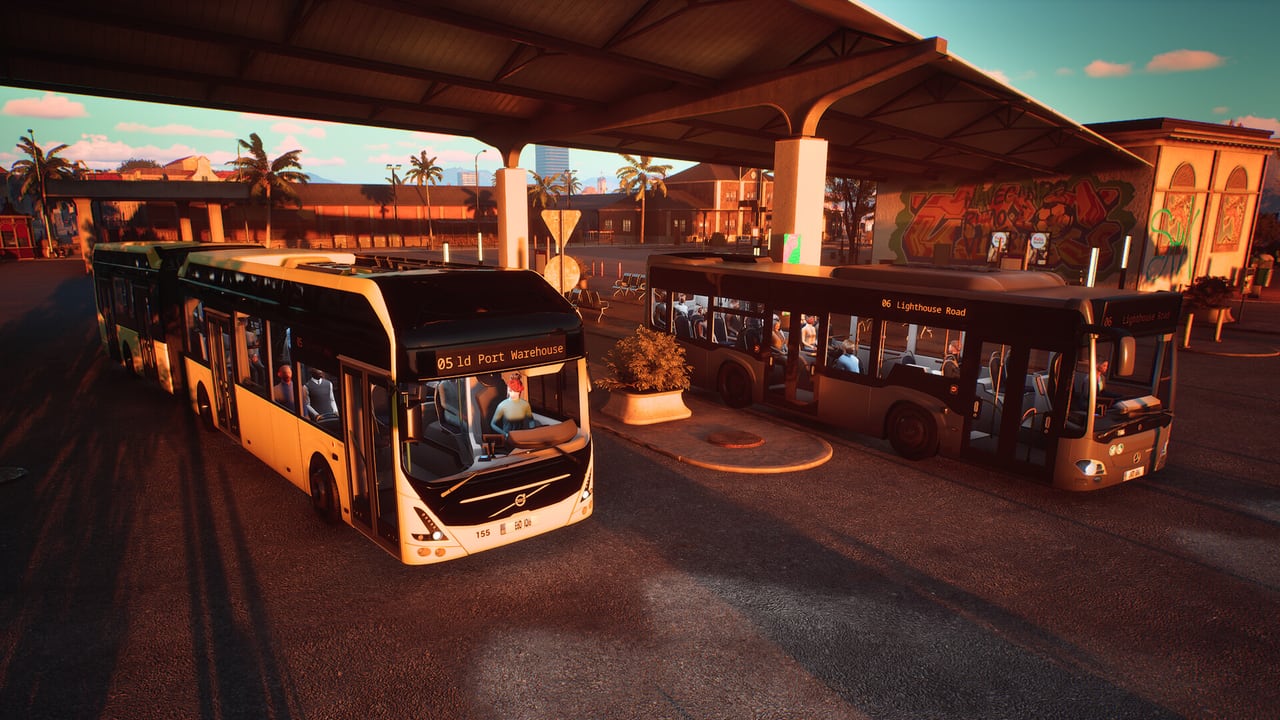
Felicia Bay runs on a full day-night cycle with dynamic weather. This is not cosmetic: night driving requires headlights, wet roads require wipers, and a rainstorm on a Mequina coastal road changes your braking distance in ways that a clear afternoon does not. This page covers how the cycle works, what equipment each bus carries, and the driving adjustments each condition demands.
The day-night cycle
The transition between day and night is seamless in Bus Simulator 27. There is no instant switch; the lighting shifts gradually across the sky as the in-game clock advances. This matters for planning: a route that runs through golden hour looks different from the same route at midnight, and the visibility conditions those times create affect how you drive.
The cycle runs continuously regardless of whether you are driving or parked. If you start a long coach run from Mequina to Alcaztelar in the late afternoon, you will arrive in the dark. The game does not pause the clock during loading screens or pause menus; the world time advances whether you are active or not.
Night operation requires headlights. Every bus in the fleet is equipped with headlights — using them at night is not optional in a simulation context. The control bindings for lights are in the controls list. In a city with street lighting, headlights are partly about your visibility of the road and partly about your visibility to other road users.
Dynamic weather
Weather in Felicia Bay changes dynamically. Rain, clear skies, fog, and other conditions develop during service rather than being set per-route. A Mequina morning that starts dry can become a rainstorm by the time you reach the coastal district. The weather system is part of what makes no two trip identical.
Rain is the most consequential weather type for driving. Wet roads reduce traction, extend braking distance, and increase the likelihood of a skid if you brake hard into a corner. City buses on Mequina’s tighter streets are more vulnerable to wet-surface incidents than the longer coach vehicles on the open road between cities.
The Solaris Urbino 12 electric and other electric buses have their own considerations in wet conditions. Electric vehicles do not have the same engine braking characteristics as diesel coaches. In rain, regeneration braking may be reduced, which means you rely more on the friction brake. Know your vehicle’s wet-weather behavior before the first storm.
Headlights and lights
Headlights are the primary night equipment. Every licensed bus in the fleet carries them as standard. The game models individual bus configurations, which means a Solaris Urbino has its own headlight arrangement and beam pattern, distinct from the MAN Lion’s Coach or the Mercedes-Benz Tourismo.
Using headlights at night is a traffic rule, not a suggestion. In Intense difficulty, driving without lights where they are required earns a traffic discipline penalty. In Relaxed difficulty the requirement is relaxed, but the visibility risk remains.
Interior lights are also modeled. A bus with its interior lights on at night helps passengers see their stops clearly. The trade-off is that a bright interior reduces your own night vision through the windshield. Some players turn interior lights off for night driving; others leave them on for passenger comfort and accept the reduced external visibility.
Windshield wipers
Wipers are the other half of wet-weather operation. Rain requires wipers, and the wiper speed should match the rainfall intensity. The wiper controls are in the standard control binding list. Using wipers at the wrong speed — too fast for light drizzle, or too slow for heavy rain — impairs visibility without improving it.
Wipers are also relevant for the cleaning system. A dirty windshield in bright sunlight requires the wash function, not just the wiper. The wash-wipe cycle is a two-step action described in the controls: spray, then wipe.
Temperature and air conditioning
All buses in the fleet are equipped with air conditioning. Official documentation confirms AC as standard equipment across all licensed models. The AC is toggleable via the Action Menu, which means you choose when to run it rather than having it automatic.
AC use has a trade-off in the simulation: it draws power from the vehicle’s electrical system. On an electric bus, running the AC reduces range. On a diesel or CNG bus, it adds a fuel consumption cost. This is part of the operating economics described in company management: a route that runs AC continuously on a hot day costs more per kilometre than the same route with AC off.
Weather and difficulty
Difficulty settings do not disable the weather system, but they affect how it interacts with your run. On Relaxed difficulty, the weather changes but passenger event frequency is reduced, which means a rainstorm on Relaxed is less likely to produce an interior disruption alongside the road condition. On Intense difficulty, rain combines with the full range of passenger events, which means you are managing wet roads and an irritated passenger compartment simultaneously.
Custom difficulty lets you tune this interaction. You can run a simulation where weather is fully dynamic but passenger events are minimal, or one where every weather change brings an interior challenge.
Night driving tips
Use your mirrors more frequently at night. Other vehicles’ headlights reflect in your mirrors in a way that daytime visibility does not replicate. A coach looming large in your rear-view mirror at night is more intrusive than the same vehicle in daylight.
Watch for pedestrians and cyclists. Other road users are less visible at night even when your headlights are on. A pedestrian crossing without a lit path is a genuine hazard in the Alcaztelar mountain districts where street lighting may be less consistent than in central Mequina.
Know your route’s lighting condition before you start. A Mequina coastal route that is straightforward in daylight becomes a navigation challenge at night if the street lamps are sparse. Plan for the condition before you leave the depot.
Related pages
Controls has the headlight, wiper, and AC bindings. How to drive covers the service loop where weather affects your timetable. Felicia Bay covers the geography and how coastal Mequina differs from the mountain city of Alcaztelar in lighting and road character. Game modes covers difficulty settings that interact with weather and event frequency.
The day-night cycle and dynamic weather are confirmed features of the full game launching 8 September 2026. They are part of the simulation whether you are in Story, Career, or Sandbox.
Frequently Asked Questions
Quick answers about Bus Simulator 27.
Does Bus Simulator 27 have a day-night cycle?
Yes. Felicia Bay runs a seamless day-night cycle. The in-game clock advances continuously, and a route started in daylight can end after dark.
How does dynamic weather affect driving?
Rain reduces traction and extends braking distance. Electric buses lose regeneration braking on wet roads. Wipers must match rainfall intensity. Wet conditions interact with passenger events on higher difficulties.
Do all buses have headlights?
Yes. Every licensed bus in the fleet is equipped with headlights. Using them at night is a traffic rule; on Intense difficulty, driving without lights where required earns a penalty.
What does air conditioning do in the simulation?
AC is standard on all buses and is toggleable. On electric buses, AC reduces range. On diesel or CNG buses, it adds fuel cost. Running AC continuously on a hot day is an operating expense.
Can I disable weather or the day-night cycle?
The cycle and weather system are always active. Difficulty settings affect how weather interacts with passenger events, but the weather itself is not toggleable.
Are headlights and wipers in the demo?
The demo runs a partial time cycle but the full day-night and weather systems are part of the launch build. Headlight and wiper controls are in the controls list regardless.